 Image 1 of 1
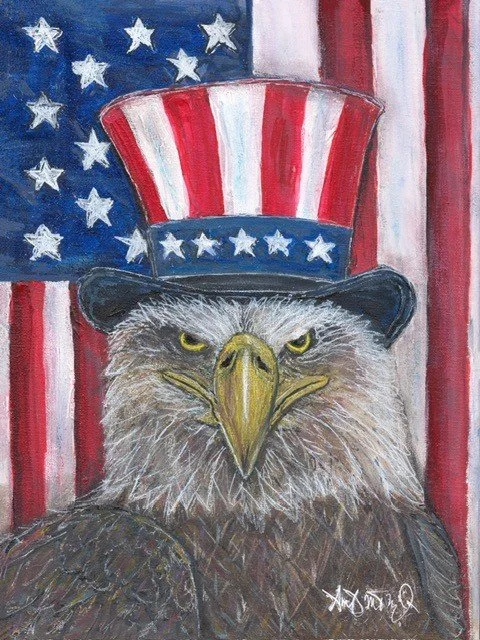
Spirit of America: Uncle Sentinel Original Acrylic on Canvas (12" x 16")
SPIRIT OF AMERICA: UNCLE SENTINEL
Anthony M. T. Majewski
2026
Acrylic on Stretched Canvas
12 × 16 inches (30.5 × 40.6 cm)
Original
Created to commemorate the 250th Anniversary of the United States, Spirit of America: Uncle Sentinel is a commanding meditation on vigilance, freedom, and the enduring ideals that define a nation. Rather than presenting the bald eagle as a familiar patriotic emblem, Anthony M.T. Majewski strips away narrative distraction and places the viewer into an intensely personal encounter with one of history's most enduring symbols of sovereignty. The result is not merely a portrait—it is a psychological presence.
The composition is remarkable for its absolute confidence. The eagle occupies the picture plane with unwavering authority, confronting the viewer in perfect frontal symmetry. Such compositions are among the most demanding in portraiture; there is no dramatic landscape, theatrical action, or decorative complexity to carry the work. Every success depends upon proportion, balance, and the artist's ability to create life through expression alone. Majewski embraces that challenge, producing a composition whose quiet restraint amplifies its emotional power.
The painting's greatest achievement lies in its extraordinary command of the viewer's attention. The penetrating golden eyes become the undeniable focal point, establishing an immediate psychological dialogue that continues long after the initial encounter. One does not simply observe Uncle Sentinel—one feels observed. This subtle reversal transforms the work from representation into experience, creating the rare sensation that the painting possesses an awareness beyond the canvas itself.
Technically, the work reveals a sophisticated understanding of acrylic as both a structural and expressive medium. Hundreds of deliberate brushstrokes construct the eagle's plumage with remarkable dimensionality, allowing cool grays, warm earth tones, and luminous whites to interact through successive translucent layers. Rather than pursuing photographic imitation, Majewski allows the physical presence of paint to remain visible, giving the surface an energy and vitality that rewards prolonged viewing. The texture catches changing light throughout the day, continually revealing new relationships between color, shadow, and form.
Equally compelling is the painting's disciplined use of symbolism. The Stars and Stripes do not function merely as patriotic decoration but as an architectural framework, their vertical rhythm reinforcing the monumentality of the central figure. The iconic hat immediately recalls generations of American visual culture, yet in Majewski's hands it becomes something more contemplative than nostalgic. History is acknowledged without being illustrated. Patriotism is suggested rather than declared. The symbolism remains open, allowing viewers to bring their own experiences and interpretations to the work.
What distinguishes Spirit of America: Uncle Sentinel is its ability to balance accessibility with intellectual depth. From across a gallery, the composition commands attention through its bold graphic clarity. At close range, it reveals extraordinary nuance—individual feather structures, subtle shifts in temperature, layered brushwork, and carefully orchestrated passages of reflected light. This duality is a hallmark of enduring paintings: they possess immediate visual impact while continually rewarding deeper examination.
The work also carries exceptional cultural resonance. Created during America's Semiquincentennial, it captures a singular historical moment while deliberately avoiding the visual language of commemoration. Instead of looking backward, Majewski asks viewers to contemplate the responsibilities that accompany freedom, the vigilance required to preserve it, and the enduring values that transcend generations. The eagle becomes less a national mascot than a timeless guardian of ideals.
Sophisticated collectors are often drawn to works that unite technical accomplishment, emotional immediacy, and cultural significance within a singular visual statement. Spirit of America: Uncle Sentinel embodies that convergence. Its restrained composition, psychological intensity, and symbolic clarity allow it to exist simultaneously as portrait, allegory, and contemporary Americana. It is a painting that reveals more with each encounter, inviting sustained reflection rather than offering instant resolution.
In Spirit of America: Uncle Sentinel, Majewski has created a work of uncommon presence. It does not ask for attention—it quietly commands it. That enduring ability to captivate, challenge, and remain memorable is among the qualities that have long distinguished paintings that continue to resonate with collectors, curators, and audiences across generations.
SPIRIT OF AMERICA: UNCLE SENTINEL
Anthony M. T. Majewski
2026
Acrylic on Stretched Canvas
12 × 16 inches (30.5 × 40.6 cm)
Original
Created to commemorate the 250th Anniversary of the United States, Spirit of America: Uncle Sentinel is a commanding meditation on vigilance, freedom, and the enduring ideals that define a nation. Rather than presenting the bald eagle as a familiar patriotic emblem, Anthony M.T. Majewski strips away narrative distraction and places the viewer into an intensely personal encounter with one of history's most enduring symbols of sovereignty. The result is not merely a portrait—it is a psychological presence.
The composition is remarkable for its absolute confidence. The eagle occupies the picture plane with unwavering authority, confronting the viewer in perfect frontal symmetry. Such compositions are among the most demanding in portraiture; there is no dramatic landscape, theatrical action, or decorative complexity to carry the work. Every success depends upon proportion, balance, and the artist's ability to create life through expression alone. Majewski embraces that challenge, producing a composition whose quiet restraint amplifies its emotional power.
The painting's greatest achievement lies in its extraordinary command of the viewer's attention. The penetrating golden eyes become the undeniable focal point, establishing an immediate psychological dialogue that continues long after the initial encounter. One does not simply observe Uncle Sentinel—one feels observed. This subtle reversal transforms the work from representation into experience, creating the rare sensation that the painting possesses an awareness beyond the canvas itself.
Technically, the work reveals a sophisticated understanding of acrylic as both a structural and expressive medium. Hundreds of deliberate brushstrokes construct the eagle's plumage with remarkable dimensionality, allowing cool grays, warm earth tones, and luminous whites to interact through successive translucent layers. Rather than pursuing photographic imitation, Majewski allows the physical presence of paint to remain visible, giving the surface an energy and vitality that rewards prolonged viewing. The texture catches changing light throughout the day, continually revealing new relationships between color, shadow, and form.
Equally compelling is the painting's disciplined use of symbolism. The Stars and Stripes do not function merely as patriotic decoration but as an architectural framework, their vertical rhythm reinforcing the monumentality of the central figure. The iconic hat immediately recalls generations of American visual culture, yet in Majewski's hands it becomes something more contemplative than nostalgic. History is acknowledged without being illustrated. Patriotism is suggested rather than declared. The symbolism remains open, allowing viewers to bring their own experiences and interpretations to the work.
What distinguishes Spirit of America: Uncle Sentinel is its ability to balance accessibility with intellectual depth. From across a gallery, the composition commands attention through its bold graphic clarity. At close range, it reveals extraordinary nuance—individual feather structures, subtle shifts in temperature, layered brushwork, and carefully orchestrated passages of reflected light. This duality is a hallmark of enduring paintings: they possess immediate visual impact while continually rewarding deeper examination.
The work also carries exceptional cultural resonance. Created during America's Semiquincentennial, it captures a singular historical moment while deliberately avoiding the visual language of commemoration. Instead of looking backward, Majewski asks viewers to contemplate the responsibilities that accompany freedom, the vigilance required to preserve it, and the enduring values that transcend generations. The eagle becomes less a national mascot than a timeless guardian of ideals.
Sophisticated collectors are often drawn to works that unite technical accomplishment, emotional immediacy, and cultural significance within a singular visual statement. Spirit of America: Uncle Sentinel embodies that convergence. Its restrained composition, psychological intensity, and symbolic clarity allow it to exist simultaneously as portrait, allegory, and contemporary Americana. It is a painting that reveals more with each encounter, inviting sustained reflection rather than offering instant resolution.
In Spirit of America: Uncle Sentinel, Majewski has created a work of uncommon presence. It does not ask for attention—it quietly commands it. That enduring ability to captivate, challenge, and remain memorable is among the qualities that have long distinguished paintings that continue to resonate with collectors, curators, and audiences across generations.